
Visuals to support autism and neurodivergent individuals


*This blog post contains affiliate links. If you purchase something using my link, I will receive a small commission from the sale. This comes at no cost to you, but is paid by the company. Please understand that if I am referring a product/service, it's because I believe in the company, the results the product/service provides, and I use it myself. I do not take being an affiliate with any company lightly.
I, Raven Holmes, am a participant in the Amazon Services LLC Associates Program, an affiliate advertising program designed to provide a means for sites to earn advertising fees by advertising and linking to amazon.com.
One of the most important things I've learned from working with individuals with disabilities is that they NEED visuals. Visuals are so very necessary to support autism and neurodivergent individuals. And to be honest, if you think about it, neurotypicals learn visually, as well, so this is not just a thing for neurodivergents. I learn best auditorily and visually. Think about all of the visual representations we have around us: street signs, assembly directions for your new bookshelf, business logo's like Ronald McDonald and the cows from Chick-Fil-A, and the list goes on, right? The way I like to think about it is: when I'm talking, am I getting through to my student? Are they following the instructions given? Do they seem to be focused or staring into outer space? Let's take my student, John for example. I've given the entire class instructions to "complete their morning warm-up and morning task," but John has not gotten started. He is staring at his warm-up, pencil in hand for 2 whole minutes. I should think he's reading, right? I don't because I know my student and I also know when he's not focused or rather, "not here with us." So I give him a verbal reminder: "John, you have 10 minutes to finish your warm-up and morning task." A few minutes later and John is still in la-la land. He only has 7 minutes left until we move on to the next activity. As I walk over to John's desk, he grabs a pencil and says, "Okay, Ms. Raven. Starting now." Has anyone else experienced this? Constantly repeating yourself over and over again? It took some time for me to understand that because of their processing disorder, information can often be delayed, misconstrued, or simply unintelligible. Also, there could be something more interesting than Ms. Raven's warm that is occupying the forefront of their brain. It could be a scene from a favorite movie, a conversation they overheard last night, or they could even be processing all of the sounds in the room at that moment; people talking, music playing, someone laughing, etc. We'll discuss this in a later post. So, if this is you, your child, or someone you know, I have a few suggestions for you.
3 Types of Visuals
Timer
Dry erase board
Pictures
Use a Timer
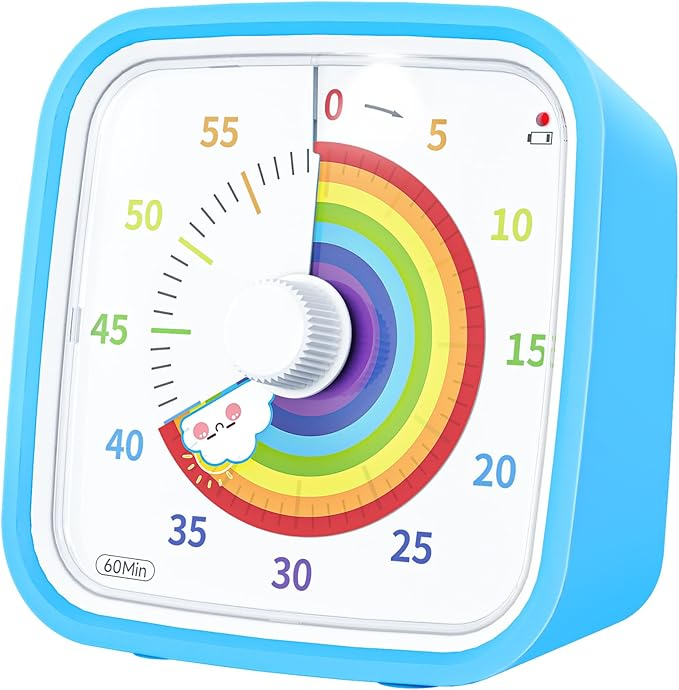
I use the simple timer for my adult autistic students and it helps so much! I usually give them a verbal reminder of the instructions along with a specific amount of time they have to complete it. It’s very important to not give too much time or too little time. Giving them too much time allows them the freedom to procrastinate while too little time will cause them to become overwhelmed. Trial and error is the best way to figure out how much time they realistically need. And keep in mind, a timer is not just an essential for autistic individuals but also beneficial for everyone.

If you struggle with time management or staying focused, then this is for you.
Use a dry erase board

I typically use the dry erase board for writing down instructions for my students. I like this dry erase board because it comes with a dry-erase marker and eraser in the set. If the instructions are too long, shorten it and modify the language (i.e., instead of “write your name and date at the top of the paper, you can say, “write name and date,” already assuming the paper is in front of them. You can write a number step-by-step process, make your list with bullet points, however you see fit.
Lastly, you can use pictures

A visual can be any pictorial or image representation that contains few to no words. The image does all of the talking giving you a clear depiction of what's going on. If you wanted to use pictures as a reference, you can use a screenshot from your phone, a picture printed off of Google images, or a software that filters real-life pictures and turns them into animations and/or characters. The visuals above are from Teachers Pay Teacher's (TPT) which is such an amazing resource. The resources are created by educators, parents, and even behavioral therapists. The resources range in cost from free to $10+. If you want something that's already created, then check them out.

If you are still struggling with using visuals, please feel free to reach out to me. I'd be happy to help!
~Raven Holmes, M.Ed
Of Earth & Echo, Founder
Which of these methods would you like to try?
Timer
Dry Erase Board
Visual Pictures
Please note that "John" and the situation describing him is fictional and any resemblance to a real person (living or dead) and/or event is strictly coincidental.
Comments